Monday, January 29, 2007

The Women Behind the Wat


After Jen and I melted into rosemary and lemongrass-scented puddles at the forest temple (called Wat Sok Pa Luang), I decided that I had to meet the pleasure-loving mind behind the herbal-infused steam baths and tropical group massage sessions. I was actually somewhat surprised to learn from Noi, the vociferous gal coordinating treatments and handing out brightly patterned “modesty” sarongs, that a Buddhist nun had created the spa, and that this devout sixty-something holy woman was actually her aunt.

Somewhat impulsively, I asked Noi if it would be possible to chat with her aunt to in order to learn how to recreate the intoxicating steam experience back home.

The skeptical New Yorker in me was pretty sure that Noi was putting me on when she immediately agreed to meet me for breakfast at a cafĂ© the next day and whisk me away to the countryside on her motorbike. Oh yes, and since her Aunt didn’t speak a word of English, she’d be translating the whole conversation.

Eight-thirty is okay then?” she asked, writing down the name of my hostel so she could find me the next day.

Of course. Sure thing. I quashed my suspicions that she might try to charge me some exorbitant fee for this whole experience and instead wondered how she could take a morning off from running the spa to shepherd some tourist around town.

“Easy, the place doesn’t open ‘til 2:00 in the afternoon,” she laughed as she broke the yoke on her eggs at breakfast the following morning. Noi seemed in no rush to get moving so we sipped a few more cups of steaming Lao coffee and let the conversation drift from business to family to the topic all 20-something women seem to care about around the world—relationships.

At 27, I learned that Noi considered herself way, way over the hill, but loathed the idea of arranged marriage (for herself anyway) and hoped, someday, to meet a guy who could keep up with her modern sensibilities and ambition. I told her lots of American girls could relate.

Noi grew comfortable enough that by the time I hopped on the back of her “moddah-bike” two hours later, she’d started to delve into Cosmo territory. I soon learned that she’d lost her virginity to a long-term boyfriend at age 24, but things between them hadn’t worked out. Since then, she’d had a small string of affairs with men she’d met at her job and was currently pining away for a young American guy who’d promised to email her after he left town two weeks ago. So far, he hadn’t.

Again, I told her American women could probably relate.

We quickly breezed out of Vientiane’s touristy historic district and I could see that Lao’s capital looked a lot like a small mid-western city in the US. Car dealership and repair shops lined the main road. Traffic was bad. Entire families were perched like circus performers on the backs of mopeds, with Dad driving in the front, Mom cradling an infant behind and a toddler sandwiched in between both parents. Pseudo-tough guys turned to stare at me as they zipped past. Noi shouted that I should keep my purse situated between us as locals had a bad habit of snatching them.

I followed her instruction and we spent the next 45 minutes or so in the comfortable silence that occurs when the wind makes it impossible to have a real conversation.

We passed acres of recently harvested farmland before finally reaching Wat Pahakounoi, where Noi’s aunt Meekow Koe Moungsen was there waiting. She only had about twenty minutes to spare, as it was nearing mealtime and she had hundreds of monk mouths to feed.

As you can see from the photo, Auntie wasn’t big on smiling and I suddenly felt awkward about grilling her on the various healing properties of herbs. Would she wonder who the heck I was, poking around her monastery and trying to poach the steam(y) secrets she’d accrued over a lifetime of practice? Was she staring at my sleeveless shirt and Capri pants and thinking what an American tart I was? Would she tell Noi to put me right back on the motorbike and take the disrespectful Westerner home?

Clearly, my neurotic New York sensibilities had kicked in again.

Despite the language barrier (as well as my bare shoulders and shins), Auntie made me feel right at home on her lovely tree-shaded meditation platform. With Noi’s help, she answered all my questions about the therapeutic benefits of lemongrass, rosemary, mint and citrus, and made some suggestions for a do-it-yourself herbal steam treatment.

After my twenty minute interview had passed and I’d snapped a few requisite photos, I stood up, prepared to let my conversation partner return to her tasks at hand. I was startled when she took my hand and gently pulled me back to a sitting position. She stared at me, intently, and said something to her niece
“She says that this not the last time you come here,” translated Noi. “You come back to learn meditation, learn about plants and you study with her, in this place. She says that she knows this and it will be in a few years.”

I turned to look at Noi, surprised, but determined not to let me inner city skeptic get the best of me this time.

“Kop Chai. Thank you,” I said, looking at Auntie who finally cracked a small smile.

I had no intention of studying Buddhism in a rural temple in Laos anytime in the near future, but who the heck knew? Maybe I’d have some Eat-Pray-Love style midlife crisis which would propel me around the world a second time to seek answers and absolution through intense meditation, 24-hour silence and self-denial.

When you’re a Lost Girl, anything can happen.

Thursday, January 18, 2007

Holy Laos!

While there are some drawbacks to following the backpacker trail - - competing for the same Lonely Planet-recommended hostels, squeezing onto over-crowded buses and trains and being constantly reminded just how much Bush sucks (for the love of God, we know already; none of us even voted for him!) - - there are definitely some advantages of taking the road most traveled, particularly in SE Asia. Not only are we surrounded by tons of fun people our age to party with (OK, maybe they’re slightly younger. Gulp!), there’s always someone around to give us the inside scoop on where to get the cheapest cocktails, how to avoid common tourist scams and which pockets of the continent are really worth visiting. In fact, if it wasn’t for the advice of several other travelers, Amanda and I would have completely missed what we now consider to be one of our favorite countries - - Laos.

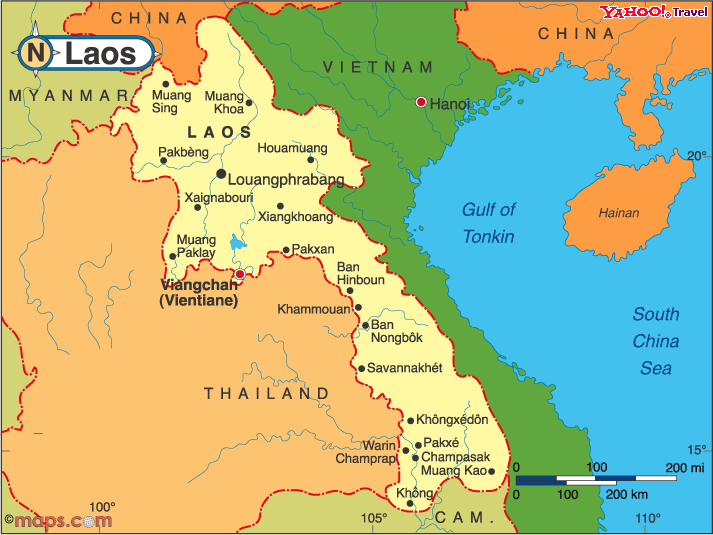
For those of you who as unfamiliar with this region of the world as we were, Laos is the thin country sandwiched between Thailand and Vietnam. Also, the ‘S’ in Laos is silent, so it’s actually pronounced like COW, but with an ‘L’. Readers: Now that you know this, feel free to take the time to reflect upon and chuckle at my witty blog title. OK, now that we’ve all acknowledged my cleverness, let’s move on…

After arriving in Bangkok (our first stop in SE Asia after leaving India), Amanda and I had about a week and a half of free time before we had to meet our friend and former NYC roommate, Beth, for a little requisite island hopping in Southern Thailand. Since we planned to hit Northern Thailand, Cambodia and Vietnam once Holly re-joined us on the road in January, we decided to do a bit of research on Laos to see if it was worth visiting. While our guide book did an excellent job painting the former French-territory as an appealing tourist destination, it was the rave reviews we got from other travelers that cemented our desire to check out the country for ourselves. Every person we polled gave Lao two enthusiastic thumbs up in all categories (in backpacker world that translates to gorgeous setting, chill vibe, comfy hostels, frequent happy hours and most importantly, uber low prices). With visions of scenic, mountain treks, yummy street food, lush beer gardens and $3 massages dancing in our heads, we immediately hopped the next overnight train bound for the Thai-Lao border.

The moment our tuk-tuk rolled onto the sunny, tree-lined boulevards of Vientiane (Laos’ capital), Amanda and I knew we’d made the right decision. Everything and everyone around us exuded a whimsical, carefree attitude - - fresh faced vacationers leisurely sipped cappuccinos at sidewalk cafes, shopkeepers charmed new arrivals with handmade silks and intricately-carved Buddhas and tight-packed clusters of monks, donning freshly shaven heads and tangerine-tinted robes, streamed from golden temple gates.


After churning in smoggy, spicy and chaotic India for almost a month, we happily melted into Laos’ relaxed culture and tranquil ambiance like marshmallows in hot chocolate. One day blended into the next as Amanda and I whiled away the hours exploring the town, shopping for clothes and jewelry in trendy boutiques and sampling tasty cuisine from local markets. But just when we thought life couldn’t get any better, we discovered an unexpected path to paradise through one of the country’s most popular tourist activities – massages.

Despite an abundance of cheap parlors on every corner, we again headed the advice of fellow travelers and decided to check out the area’s famous herbal sauna and outdoor massage center. Eager to experience a luxurious steam and rigorous, 60-min rub down – all for the bargain price of $4 – Amanda and I gladly braved the bumpy 3km ride deep into the woods in search of Vientiane’s legendary ‘spa’. Like every tuk-tuk driver in town, ours knew exactly how to get to the secluded wat paa (forest temple) but after dropping us off at the entrance, we were on our own. Amanda and I wound our way down the long gravel road past ramshackle huts, dingy hammocks and the occasional barn yard animal, hoping we were headed in the right direction. We followed a convoluted series of hand-scribbled posters and several ambiguous gestures from the resident monks for nearly 10 minutes until we heard a voice from above directing us where to go. “You want steam and massage?” “Come this way!”

Perched 30 feet above ground, nestled in the tree tops, was a makeshift wooden platform packed to the brim with tourists in bathing suits and terry cloth robes. Amanda and I climbed slowly up the rickety staircase to join our fellow hedonists in the large ‘foyer’ and put our names on the list for treatments. After changing out of our clothes, we were handed a silk cover up and led into an attached outhouse-like structure. A wave of sweet, hot steam smacked us in the face as we blindly felt around for an empty bench, tiptoeing carefully around the hissing coals packed in pots on the floor and trying desperately not to sit on someone else’s lap by mistake. We finally found an empty board and reclined back against the wall prepared to sweat off at least ten pounds. It didn’t take long before we were puddles on the floor, infused from head to toe with the sauna’s magic blend of lemongrass, eucalyptus, citrus, rosemary and mint that we’re pretty sure also included a ‘special’ herb to give guests an extra kick. Hey! Who are we to deny the effectiveness of ancient Lao healing practices?

When we couldn’t stand the scorching temperatures any longer, we stumbled outside and flopped down on one of the many massage beds that packed the wide back porch. Along with about 8 other people, Amanda and I spent the next hour being pulled and stretched like salt water taffy by hyperactive and overzealous little men. Snaps, crackles and pops filled the air as each of our body parts, which were now incredibly limber and malleable from the steam bath, were adjusted one by one and kneaded into perfect shapes. What looked and sounded like medieval torture was actually one of the most blissful and satisfying experiences we’d had since leaving yoga school (see ‘Om’ My God blog for details). Pumped full of endorphins, we floated back down to the ground and settled into a tuk-tuk alongside other satisfied customers.

To add a perfect ending to an already perfect day, we accepted an offer from our driver and fellow passengers, two local girls and a French couple, to grab a sundowner at a popular outdoor bar in town (these invitations are oddly commonplace in the backpacker community). As the sun melted into the Mekong River, we raised our super sized bottles of Beer Laos and toasted to the many more yet to come!

---Jen

Sunday, January 7, 2007

The Beach Girls

ADP: Until now, we’d spent weeks struggling to keep pace with frenetic, chaotic, religion-centric, sanitarily challenged, confusing, stimulating and draining India. But here in Goa, we finally had a chance to dig our heels in the copper-colored sand, lean back in a plastic chair and finally relax.

Sure, the local salespeople were still aggressive as hell (“Hello-where-are-you-coming-from-where-do-you-go? Look at my skirts/jewelery/antiques/paintings/saris! Ees free to look!”), but once we got past the hard sell, we found that most folks were just happy to have a conversation for no extra charge.

After waving off the first 170 young women and children loaded down with wares-for-sale on the beach, we couldn’t help but fall into conversation with a gorgeous 15-year-old girl named Rebecca. Even after we swore that we hadn’t brought enough cash to pay for a new beaded necklace or tunic top, she stuck around and chatted us up like guests on a Barbara Walters special.

She told us all about the ins-and-outs of selling stuff on the beach—she did it to support her younger brother and sister, pay for them to go to school and to put food on the table. Since her parents had passed away, she’d stepped up to the challenge of becoming the head of the household—a notion that boggled our minds, but didn’t seem to be too out of the ordinary for Rebecca.

“Do you ever get harassed by the men you sell to on the beach,” Sarah asked. “Are you ever afraid to go walking back to your house after dark?

Rebecca contemplated the questions. “Naw. The other ladies selling on the beach, we team up and make the walk back to our houses together. One time this man tried to touch me, and I just stood right up and told him to bugger off!”

I was completely impressed by this little lady who, despite never having attended school herself, seemed sharper and more motivated than most of the young women I’d once interviewed for internship positions back in New York. While I’m normally the first one of the three of us to discourage giving money to kids on the street (or beach in this case), I knew that I had to do something to help Rebecca.

We offered to buy her a meal (she declined) but she gratefully accepted the pens and school supplies that I dug out from the bottom of my daypack.

“For my little brother and sister,” she said, solemnly, turning to head for home before the sun sunk too low behind the clouds.

As I watched her walk away, I felt a weird mixture of pride and aching for someone so young who’d already experienced such a tough grown-up life.

The next day, we switched to a guesthouse a couple of breaks away from Rebecca’s spot on the beach. I kept an eye out, hoping she’d wander my way again. We never ended up running into her, but I replenished my supply of pens and pencils—just in case.

Thursday, January 4, 2007

Fear Factor

HCC: Sure, travel involves risk: Robbery, bombings, bird flu. But we’ve already addressed the fact that taking a trip is no more dangerous than driving your car (you’re much more likely to die in an accident only a few miles from your home). Yet with the government issuing travel advisories to Lost Girl locales such as Kenya and Indonesia, we’ve kept our pocketknives close and expected the worst.


So far, we’ve been pleasantly surprised (knock on wood): We’ve experienced 0 incidents of robbery, 0 bouts of avian flu and 47 unwanted sexual advances (which is roughly on par with what we’d get after five months in the New York bar scene). Cities hyped as dangerous, such as Rio and Nairobi, left us unscathed.

Still, the warnings persist. During a layover in a Mumbai airport, newscasts portraying mosque bombings in the Indian state left me more than a little nervous. And we recently opted to take the 17-hour train ride from Bangalore to Trivandrum rather than the hour-and-a-half flight not just because we’re cheap ($10 compared to $86 when pricing last-minute tickets), but also because CNN reported that all south Indian airports were being targeted by Al Queda during our time of travel.

Sure, shacking with cockroaches and sleeping on the third bunk of a coffin-like train car isn’t exactly my idea of traveling in comfort, but sometimes it’s better to be safe than sorry. Besides, botched travel plans often evoke big epiphanies.

Case in point: I didn’t realize you had to pack your own food for the 17-hour ride with a coach class ticket. A mother of two toddlers wearing torn clothing saw that I didn’t have any lunch and offered to share hers-part of a banana. Feeling guilty, I tried to refuse. She adamantly insisted, then nodded in approval as I chowed down. This is just one of many moments I’ve experienced on the road that have shown me the world outside U.S. borders is far more friendly than it is hostile—even if many media images portray it differently.

Coincidentally, I read a Conde Nast Traveler article during the ride by Jeffrey Taylor that really hit home. Here’s a quote: “The greatest though often most elusive benefits of travel are, after all, friendship, romance and a first-hand understanding of the rest of the world. Our times are admittedly troubled, so we could do with a lot more of all of these, which might lead to something called wisdom, an attribute lacking in both government announcements and media reports. So browse the warnings before you go, but go.”

I’d love to hear your thoughts: Do you think Americans' fear of travel is responsible or alarmist?
Holly